
Handmade Knitwear - why Australian women appreciate slow fashion
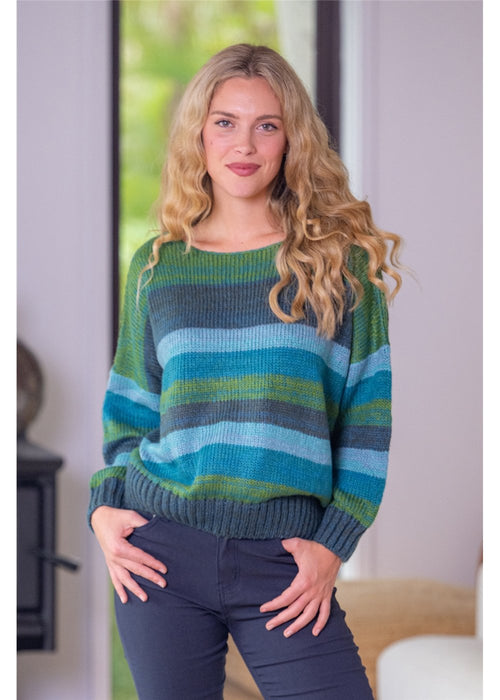
Celebration: it's time for snuggling down in handmade knitwear. Australian women who've found the good stuff know it - one well-made knit you trust completely is worth twelve of the wrong kind. So we made an edit of what's worth buying right now.
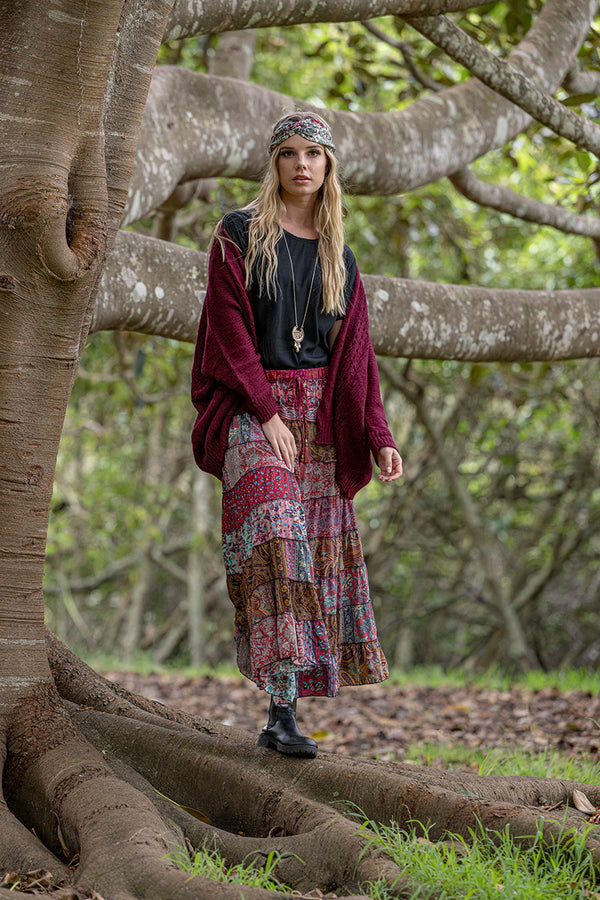
The Lush Cardi: four colours, one answer
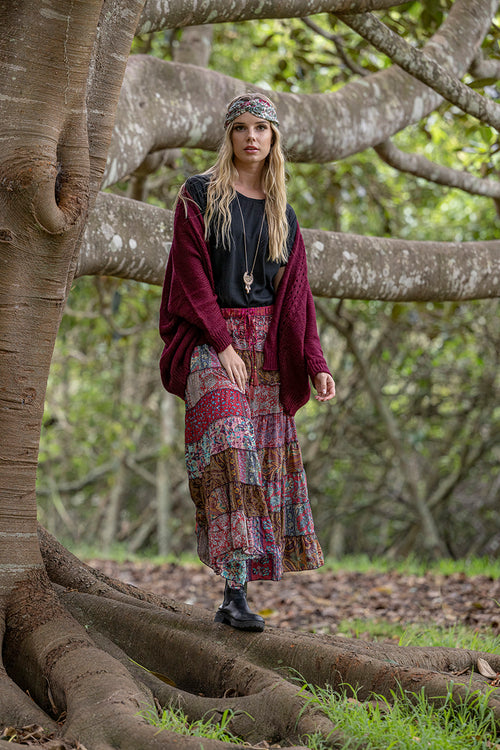
At $130 AUD, the Lush Cardi sits at the entry point of Cienna's knit collection. It comes in oat, black, khaki, and wine, fits up to a size 16, and is handmade on traditional hand-knitting machines in Indonesia. Designed in Australia by Sarah Griffin, made by the same Indonesian families Cienna has worked with for fifteen years.
The fibre is a mohair-acrylic blend. Some people see "acrylic" and hesitate. No stress: in this blend, the acrylic adds resilience and softness while the mohair gives loft and warmth. The result is a cardi that sits comfortably against the skin without the itch that makes pure mohair difficult for some people. The product states it directly - "very soft and snuggly, no itch" - which is not a trivial claim. For women who've spent years loving the look of mohair and hating the feel of it, this is the answer.
Size inclusivity at an independent label is not something to take for granted. The fact that the Lush Cardi fits to a size 16 and comes in four colourways signals that the piece was designed for women who actually exist, not a sample size that does.
The Lush Cardi does what a good cardi should: it goes over almost anything, feels amazing, and it doesn't need to be thought about once it's on. That's slow fashion knitwear doing what it's supposed to do.
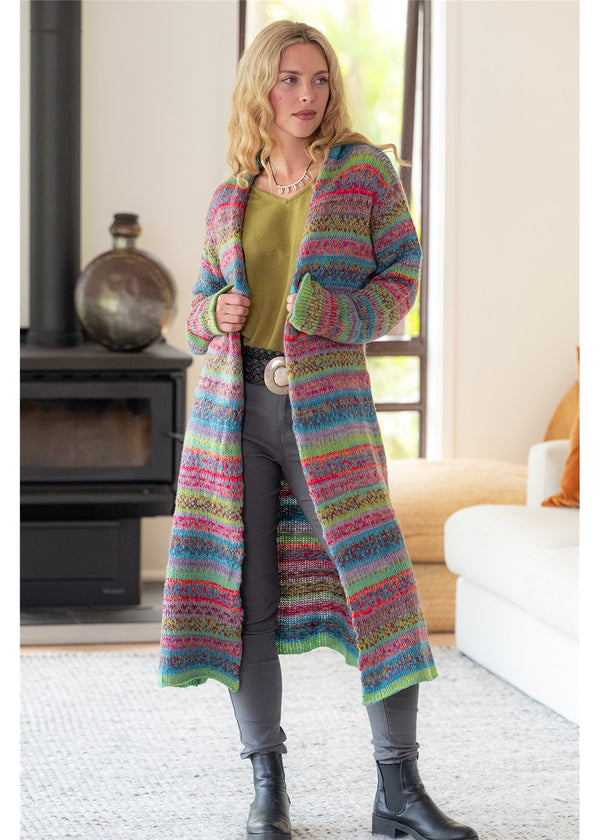
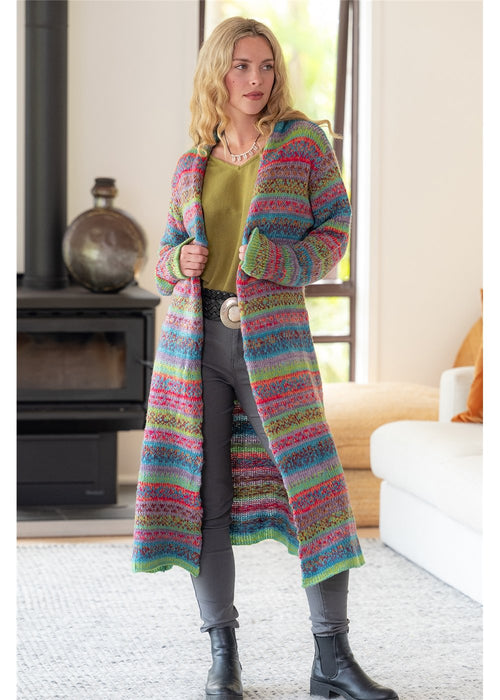
The Vail Coatigan ($210 AUD) is a different proposition. It's a full-length piece — 110cm — in the same mohair-acrylic blend, with side pockets and a striped pattern in cerise, chartreuse, and sky blue.
What justifies the price is partly the scale — this is outerwear, not a layering piece — and partly the construction. On a striped handmade knit, every colour change requires the knitter to stop, cut, and rejoin the yarn. By hand. Each one. That's what makes a $210 piece genuinely different from a $50 striped jumper from a fast fashion retailer: the time is irreducible. The pattern doesn't pull or shift, because it was made by someone who had to stop and think at every change. For women who want to invest in one considered piece this autumn, the Vail Coatigan is the argument for spending more once, rather than less more often.
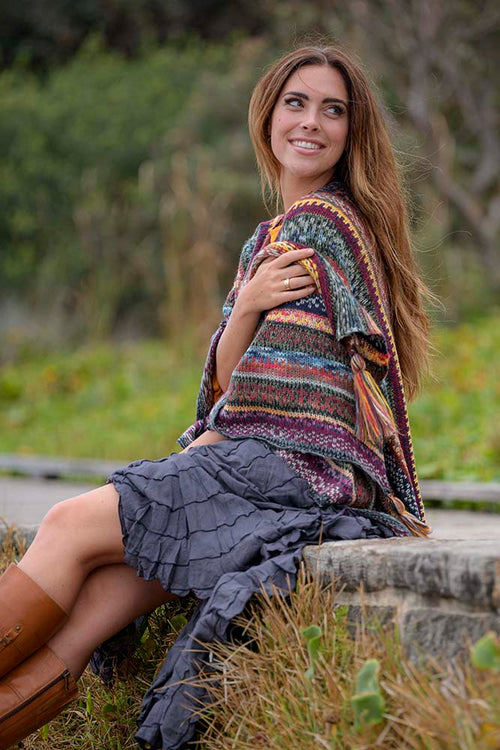
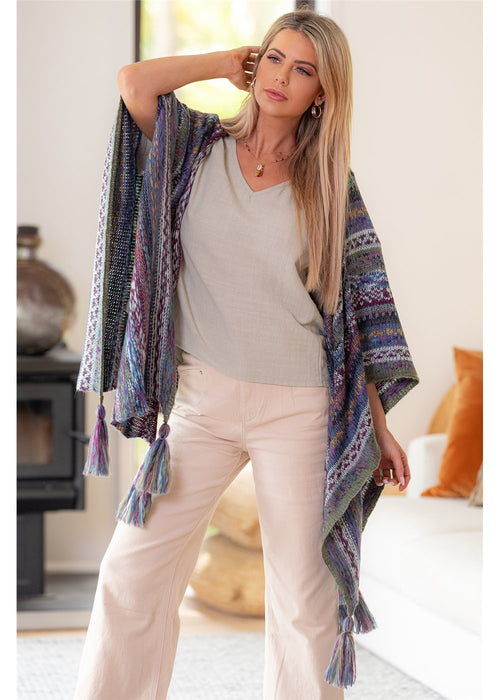
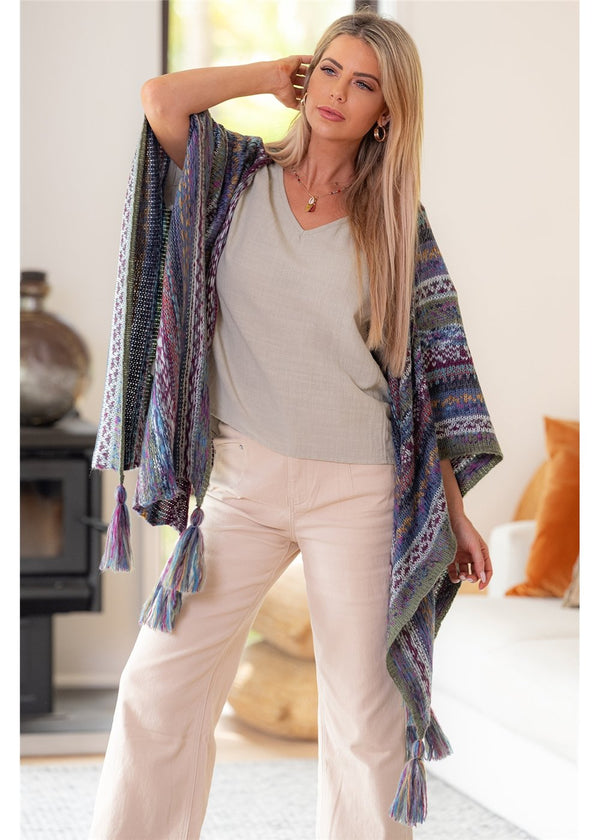
The Lugano Wrap ($150 AUD) and Lugano Poncho ($145 AUD) are for women who have settled the question of whether a knit needs to be structured. It doesn't. Both pieces are mohair-acrylic in a blues, mauves, and green stripe — the Wrap at 120cm by 68cm, the Poncho at 130cm across. Worn over a plain top or a simple dress, either becomes the whole outfit. That's not an accident of styling. That's what a generous, well-made handmade mohair knit does when it's designed for exactly this purpose.
What makes handmade knitwear worth the investment in Australia
The case for investing in the handmade knitwear Australia's independent labels produce comes down to three things: longevity, construction, and what you're actually paying for.
A machine-made fast fashion knit might cost $40 and hold together for two seasons before the fibres shift and the shape gives up. A handmade mohair-acrylic piece, cared for properly, lasts a decade. The maths isn't difficult.
None of these are fast to make and none of them are priced to pretend otherwise. Women who know their wardrobe understand that distinction. It's the difference between a piece that earns its spot and one that fills it until something better comes along.
The three fibres that define quality ethical knitwear in Australia each do different things, and the differences are practical rather than hierarchical.
Mohair comes from the Angora goat. High loft — meaning the fibres trap air for warmth without significant bulk — and naturally lustrous. In a blend with acrylic (as in all of Cienna's pieces), the itch risk that puts some people off pure mohair is substantially reduced. The result is a knit that sits comfortably against most skin types, including those that don't usually tolerate wool.
Merino is finer than standard wool and considerably softer. It's the fibre behind most Australian made knit jumpers in the moderate-price segment because it's technically versatile: moisture-wicking, relatively lightweight, good next-to-skin comfort. Pure merino pills faster than a mohair blend and needs careful washing, but the softness is consistent and the warmth is reliable for most of an Australian autumn.
Alpaca is naturally hollow-fibred, which gives it a warmth-to-weight ratio that nothing else quite replicates. It's also lanolin-free, making it genuinely hypoallergenic — useful for people who find both wool and mohair difficult. The handle is different from merino: less springy, more silky. If you've ever worn a good alpaca piece and wondered why it feels unlike everything else, that's the hollow fibre at work.
No hierarchy here. Different fibres for different purposes, different bodies, different weeks of the season.
At Cienna Designs we choose the mohair blend, loved by our customers (who kind of can't help themselves and come back to buy more.)
How to look after handmade knits
Cold water, a gentle wool wash, and a flat dry. Do not hang a wet knit: the weight of the water will stretch it out of shape. Do not tumble dry. Do not iron directly on the surface.
Pilling is normal, particularly at friction points — underarms, where a bag strap crosses the shoulder, anywhere the fabric rubs consistently. A fabric shaver used lightly will deal with it.
For mohair specifically: the fibre is lofty and benefits from air. If you compress a mohair piece in storage for months, it may lose some of its volume. Store flat where possible, or loosely rolled. A cedar block in the drawer handles moths without the chemicals of a mothball.
With that level of care, a well-made handmade knit lasts years. Possibly a decade, possibly longer. The Lush Cardi you buy this April is the piece you'll still be wearing in 2034. That is the investment case, stated plainly.
Autumn's the time where we find relief from the summer heat, but the proper cold of winter hasn't bitten yet. Handmade knits bring a sense of care you just won't get from mass-produced pieces and it works both ways ... care from the creator to you, and from you to the families that made it.
Thank you for your submissions!